
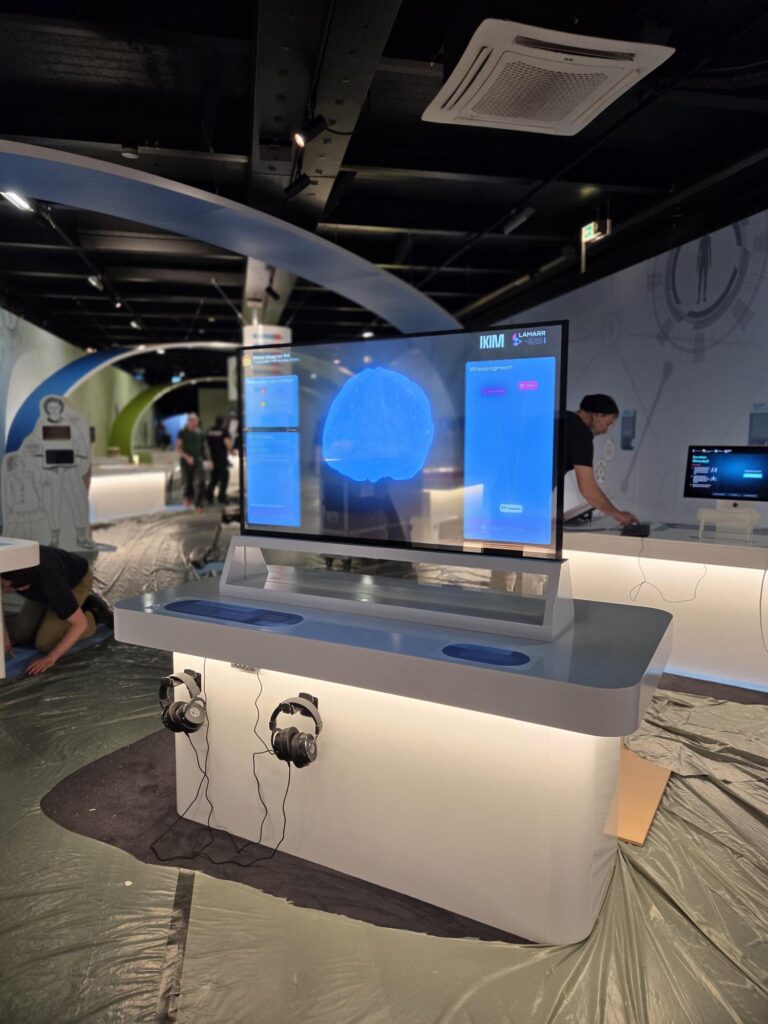
This project presents an interactive digital twin application designed to introduce children to the concepts of artificial intelligence, decision-making, and causality. Through an engaging medical scenario, users explore how AI systems make recommendations and where they can fail when relying solely on correlations rather than true cause-and-effect relationships.
The experience centres on a virtual patient, Elena, whose treatment depends on understanding hidden causal factors in medical data. Participants are invited to investigate her case, identify misleading patterns, and “teach” the AI to make better decisions. By transforming abstract AI concepts into a tangible, playful experience, the application fosters critical thinking and awareness of AI’s limitations and potential in medicine.
The installation was specifically designed for public engagement in a mobile exhibition setting, making complex scientific ideas accessible to a broad, younger audience.
For more information on MS Wissenschaft see https://ms-wissenschaft.de/en/.
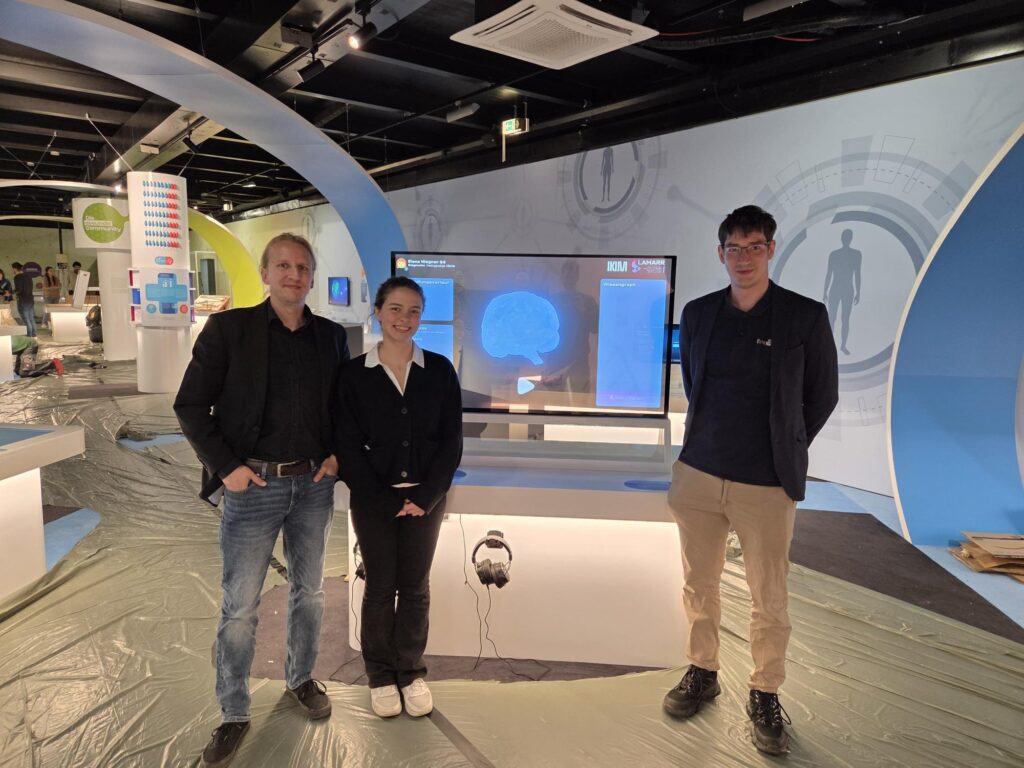
Partners
- Institute for Artificial Intelligenz in Medicine (IKIM), Universitätsmedizin Essen
- Lisle Faray de Paiva, Dr Osman Mian, Gijs Luijten, Ana Sofia Santos, Dr Julian Friedrich, Prof. Jens Kleesiek and Prof. Jan Egger
- Institute for Machine Learning and Artificial Intelligence (LAMARR), TU Dortmund
- Prof. Michael Kamp, Max Waidhas, Michel Eisenberg, Ann-Kathrin Oster