
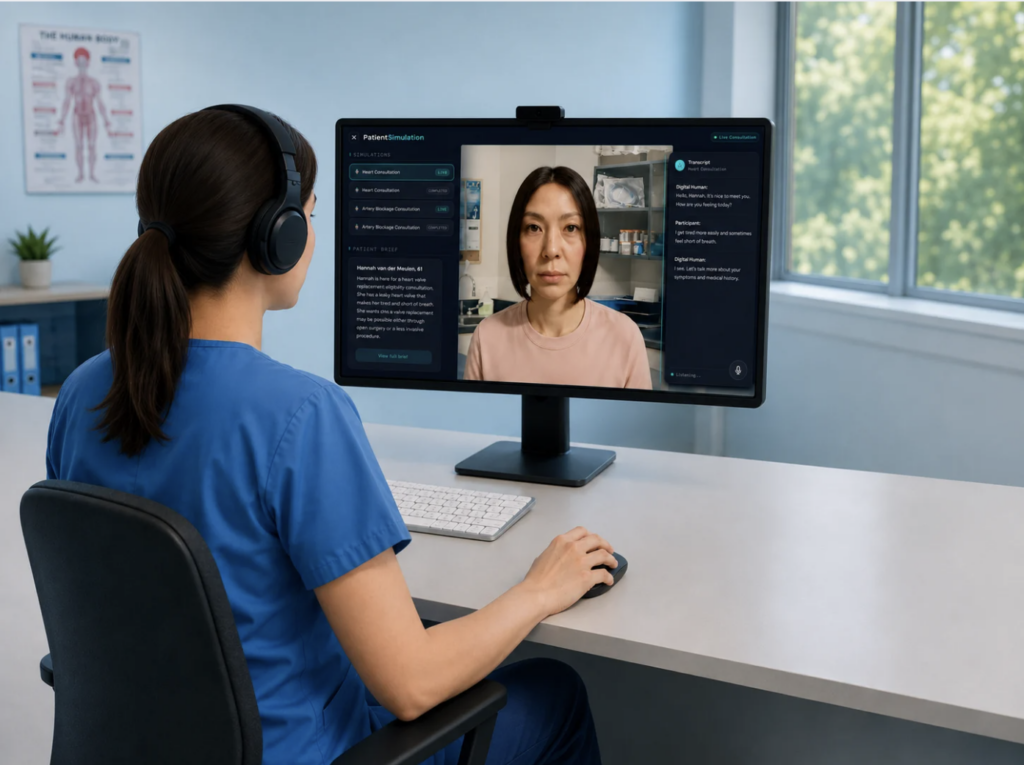
Effective communication is a fundamental clinical skill, influencing patient trust, diagnostic accuracy, treatment adherence, and overall quality of care. However, providing medical students with sufficient opportunities to practice patient interviews can be challenging due to limited access to standardized patients, scheduling constraints, and safe, controlled learning environments.
Digital Humans offer a promising alternative by enabling realistic, conversational interactions with virtual patients. In this use case, a Digital Human was developed to support communication skills training through real clinical scenarios. Each virtual patient was provided with a complete clinical case, including medical history, presenting symptoms, and relevant contextual information, allowing students to conduct natural patient interviews.
Throughout the interaction, learners can ask open-ended questions, explore the patient’s symptoms and concerns, gather clinically relevant information, and practice empathetic communication in a realistic setting.
This use case highlights the potential of AI-powered Digital Humans to complement traditional medical education by offering scalable, immersive, and interactive communication training experiences.
Project Partners
Institut für Künstliche Intelligenz in der Medizin (IKIM)
- Prof. Jan Egger
- Prof. Jens Kleesiek
- Ana Sofia Ferreira Santos
- Gijs Luijten
- Lisle Faray de Paiva
- Osman Çinar-Koraş
INSIDE:INSIGHT
Contact
Ana Sofia Santos (ana.ferreirasantos@uk-essen.de)